A direct comparison of pricing, deployment model, and time to value for SOC 2, ISO 27001, and HIPAA compliance automation — updated September 2026.
Quick Answer
Choose ComplyRim CRS if: You are an AWS customer who wants to go from zero to an audit-ready readiness report in under 30 minutes, starting at $99.99 per scan, deployed as AWS infrastructure inside your own region.
Choose Drata if: You have an established compliance team, an annual budget in the $7,500–$25,000+ range, and you need a continuous evidence-collection platform with deep workflow management across 250+ integrations — or you need FedRAMP package automation with OSCAL export.
These are not substitutes. One is a readiness assessment you run in half an hour. The other is a compliance program you operate all year. Most of the decision comes down to which of those you actually need this quarter.
At a Glance: ComplyRim vs Drata
| Feature | ComplyRim CRS | Drata |
|---|
| Entry price | $99.99 per scan (published) | $7,500/year (quoted on a call) |
| Median contract | — | ~$24,600/year (Vendr, 222 purchases) |
| Free trial | 14 days | Yes |
| Published rate card | Yes | No |
| AWS deployment model | CloudFormation (native) | API integration |
| Runs in your AWS region | Yes | No — hosted by Drata |
| Billed against AWS committed spend | Yes | No |
| Read-only IAM role | Yes | No |
| Time to first report | Under 30 minutes | 4–8 weeks to a full program |
| Automated checks | 200+ AWS checks | Continuous, 250+ integrations |
| Output format | Auditor-formatted PDF report | Continuous monitoring dashboard |
| Frameworks scored | 7 in a single scan | 30+ across the platform |
| FedRAMP | Readiness scoring only | Deeper — all 4 baselines, OSCAL-native |
| Continuous evidence collection | No | Yes |
| AWS Marketplace | Yes (primary distribution) | Yes (ISV Accelerate) |
| Target buyer | First-audit AWS teams, mid-market | Established compliance teams |
Where Drata is stronger, this table says so. A comparison page that never concedes a point is not a comparison — it is an ad, and buyers discount it accordingly.
Pricing Comparison
ComplyRim CRS
The ComplyRim Readiness Snapshot (CRS) starts at $99.99 per scan on pay-as-you-go, with Standard at $799.99/month and Premium at $4,499.99/month. It is sold through AWS Marketplace, which means:
- No separate vendor invoice and no new vendor relationship
- It draws down your existing AWS committed spend
- Billed through the AWS account you already have
- Deployed by CloudFormation template in under 30 minutes
For teams that already carry AWS committed spend or credits, the cost is effectively absorbed by a commitment they have already made. There is no multi-year lock-in at the entry tier. The full tier structure is published on the CRS product page.
Drata
Drata's entry plan (Foundation) starts at $7,500/year and typically covers one pre-mapped framework for a team under 50 people. Advanced runs roughly $15,000–$25,000/year for two to three frameworks, and Enterprise starts around $25,000 and climbs past $100,000.
Drata does not publish a rate card — every figure above comes from procurement data and buyer reports rather than a public pricing page. Vendr's procurement dataset puts the median Drata contract at approximately $24,600/year across 222 tracked purchases, which is the number worth planning against, because it reflects what companies actually sign rather than where the ladder starts.
Costs that commonly sit on top of the advertised entry rate:
- Additional frameworks beyond the one included
- TPRM (third-party risk management)
- Trust Center features
- Additional user seats
- Questionnaire response automation
The renewal, not the product
Drata is a well-regarded product — 4.7 out of 5 across 1,300+ G2 reviews, with consistent praise for customer success responsiveness, dashboard quality, and auditor workflows. The recurring complaint in public reviews and procurement forums is not about the software; it is about year two.
What buyers report publicly: default renewal uplifts in the 10–25% range, higher when headcount or framework count grows; independent write-ups describing year-two increases across a 10–40% band; and individual accounts of renewal quotes rising well beyond that, including a documented case of a $7,500 quote moving to $20,000 to enable two additional frameworks. These are aggregated buyer reports on review sites, not audited disclosures — treat them as what customers say happens, and get your own renewal terms in writing before you sign.
The structural point for an AWS buyer is narrower and easier to verify: adding a framework to CRS does not reopen a contract. A single $99.99 scan scores all seven frameworks it covers, so framework scope is not a commercial negotiation.
Price gap, stated precisely
Comparing annual cost to annual cost, CRS pay-as-you-go ($99.99/month, $1,199.88/year) is roughly 6x cheaper than Drata's Foundation entry plan and about 21x cheaper than Drata's median contract. Those two figures answer different questions: the first is what it costs to start, the second is what it costs to be a normal Drata customer.
But price is the weaker half of the argument, and it moves whenever a competitor reprices. The durable difference is that one of these numbers is on a web page and the other arrives after a sales call. Every compliance platform in this category will quote you a number on a call. ComplyRim's is published: $99.99, on your AWS bill, against your committed spend.
AWS Deployment: Native Deployment vs API Integration
This is the single most important technical difference between the two tools, and it is the one that does not change when either company adjusts pricing or ships a feature.
ComplyRim: deploys as AWS infrastructure
ComplyRim uses a CloudFormation template, which means:
- You provision it the way you provision any other AWS resource
- It runs in your AWS region — assessment data does not leave your environment
- It uses a read-only IAM role with temporary STS credentials — no agents, no installation, no production impact
- It inherits your AWS security posture at the infrastructure level
- It is billed through your existing AWS account
This is not an integration. It is a deployment.
Drata: integrates with AWS over API
Drata connects to AWS through API integrations, which is a meaningful architectural difference rather than a defect:
- Data flows from your AWS environment into Drata's hosted platform
- You establish and maintain API connection credentials
- Your compliance evidence is stored in Drata's environment
- There is no CloudFormation deployment and no read-only IAM role model
That architecture is what makes continuous, cross-system evidence collection possible in the first place — Drata has to reach GitHub, Okta, Workday and your cloud accounts to do its job, and none of that is expressible as a single CloudFormation stack. The tradeoff is real in both directions. If your security review turns on where data lives and what permissions a vendor holds, the deployment model is the question to ask first.
Time to Value
ComplyRim CRS
- Subscribe on AWS Marketplace
- Deploy the CloudFormation template (under 30 minutes)
- CRS runs 200+ automated checks across IAM, S3, CloudTrail, VPC, EC2, RDS and KMS — the infrastructure scan itself completes in 4–6 minutes
- Answer a 40-question guided self-assessment covering the controls no scanner can see
- Receive a 0–100 readiness score with letter grades, a gap analysis, and a prioritized four-phase remediation roadmap with AWS Console instructions
Total time from zero to an auditor-formatted report: under 30 minutes. The output is a PDF you can hand to an auditor before the engagement begins, not a dashboard screenshot.
Drata
Drata's onboarding involves procurement and contract negotiation, integrating the relevant systems across your stack, configuring controls for your chosen framework, and building out evidence collection workflows. For a company starting from scratch, expect 4–8 weeks before the first meaningful evidence summary is complete.
That is not slowness — it is what standing up a continuous compliance program costs. Drata is built for companies running a program all year, not for one-time readiness assessments.
Framework Coverage
This is the section most comparison pages get wrong, including an earlier version of this one. Drata's framework library is broader than ComplyRim's, and on federal frameworks it is meaningfully deeper.
| Framework | ComplyRim CRS | Drata |
|---|
| SOC 2 Type II | Readiness scoring | Full program |
| ISO 27001:2022 | Readiness scoring | Full program |
| HIPAA | Readiness scoring | Full program |
| PCI DSS v4.0 | Readiness scoring | Full program |
| ISO 42001 (AI management) | Readiness scoring | Pre-built framework; Drata is itself ISO 42001 certified |
| FedRAMP | Readiness scoring | All 4 baselines, OSCAL-native, 20x Low pilot authorization |
| CMMC | Readiness scoring | Yes |
| NIST 800-53 / 800-171 | Via framework mappings | Yes — the platform's control spine |
| EU AI Act | Not scored | Yes |
| GDPR | Not scored | Yes |
| Total frameworks | 7, scored in one scan | 30+ |
Read that table carefully, because the columns are not measuring the same thing. CRS produces a readiness score against seven frameworks in a single scan — where you stand today, what is failing, and what to fix first. Drata operates a compliance program against 30+ frameworks — continuous evidence collection, control ownership, audit packages.
On FedRAMP specifically, Drata is the stronger tool today: pre-built frameworks for LI-SaaS, Low, Moderate and High baselines, control mapping onto NIST 800-53, OSCAL as a native format, and its own FedRAMP 20x Low pilot authorization. If FedRAMP package automation with OSCAL export is a hard requirement, that is a reason to choose Drata and this page will not pretend otherwise. CRS tells you how ready you are; it does not assemble the package.
AI governance: both majors now cover it
Drata declared AI agent governance a category on June 10, 2026 and moved AI Agent Governance to limited availability on August 4, 2026 — discovery, monitoring and traceability for AI agents running inside an organization. Vanta shipped a comparable AI governance capability in the same period. Any comparison page claiming the major platforms have AI governance on a roadmap is out of date.
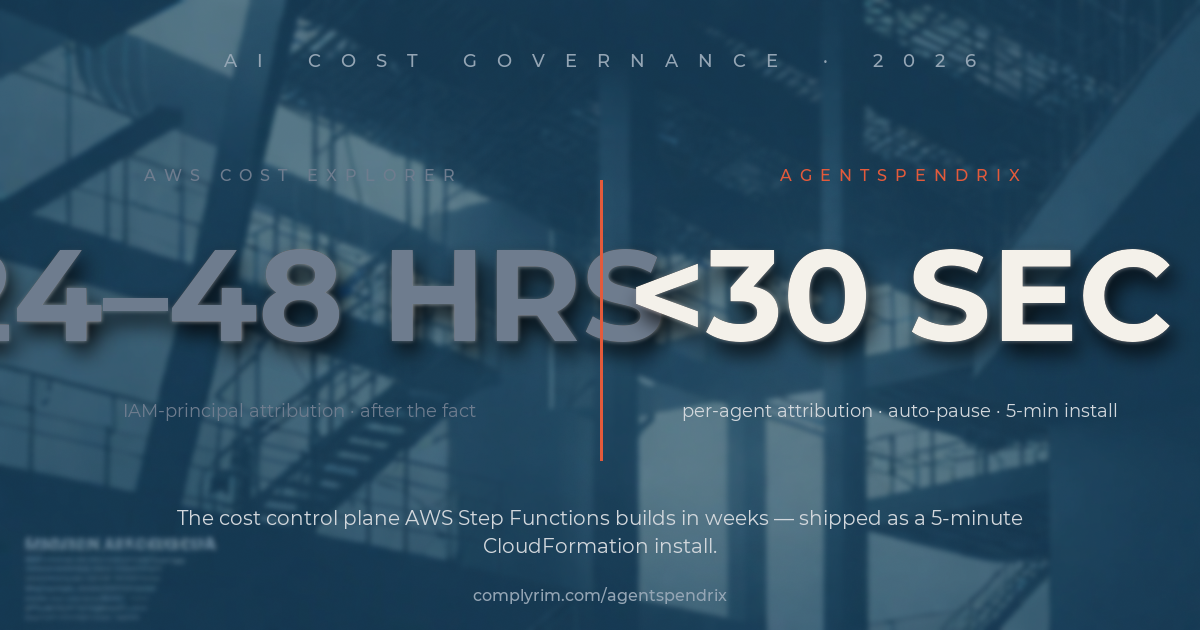
What neither compliance platform offers is per-agent cost attribution — knowing which agent spent what, rather than whether an agent is policy-compliant. That is a different question from governance, and it is the one AgentSpendrix answers, in 30 seconds rather than the 24–48 hours a billing-cycle reconciliation takes.
Deployment and Setup
ComplyRim setup
- AWS Marketplace → subscribe to CRS (14-day free trial)
- CloudFormation template deploy (under 30 minutes)
- Read-only IAM role provisioned automatically with temporary STS credentials
- CRS scans 200+ controls across your AWS environment
- Report generated — review the gap analysis and remediation roadmap
No agents. No software installation. No production impact. The read-only role means CRS can observe your environment without the ability to change anything in it.
Drata setup
Drata's setup requires integration with the systems that hold your evidence — cloud providers, code repositories, HR systems, project management, endpoint management, and identity providers. Each integration has to be configured and tested.
This is not a criticism. It is how a continuous compliance program works, and the breadth of Drata's integration library is one of its genuine strengths. But it is a real setup investment that delays your first output, and it is the wrong shape of investment if what you need is an answer this week.
The Audit-Ready Output Question
Both tools produce output designed to satisfy auditors. The difference is format and audience.
ComplyRim CRS output:
- Readiness score from 0–100 with letter grades, severity-weighted
- Gap analysis naming the specific controls failing or not implemented
- Prioritized four-phase remediation roadmap with AWS Console instructions
- Exportable PDF formatted for auditors
- 200+ checks mapped to SOC 2, ISO 27001, HIPAA, PCI DSS, ISO 42001, FedRAMP and CMMC requirements
Drata output:
- Continuous control monitoring dashboard
- Automated evidence collection from integrated systems
- Trust Center for sharing posture with customers
- Audit export packages for auditor engagements
For a first-time audit buyer, the CRS report format is usually more immediately useful — it documents current posture and shows exactly what is being remediated. For a company in its third SOC 2 cycle, a dashboard with a year of collected evidence behind it is worth more than any point-in-time PDF.
Who Should NOT Use ComplyRim CRS
- Teams that need continuous evidence collection. CRS is a point-in-time assessment. If you need evidence gathered automatically all year for a Type II observation window, that is Drata's job, not ours.
- Teams pursuing a FedRAMP authorization package. CRS scores FedRAMP readiness. It does not generate an SSP or export OSCAL.
- Large enterprises with dedicated GRC teams and six-figure tool contracts. You already have the infrastructure.
- Companies with no AWS footprint. CRS deploys as AWS infrastructure. Azure-only or GCP-only environments are not served today.
Who Should NOT Use Drata
- Teams who need results this week, not this quarter. The setup timeline and contract model favor long-running programs over rapid pre-audit assessment.
- Teams without a five-figure annual compliance budget. A $7,500 floor and a ~$24,600 median contract put it out of reach for most seed and early Series A companies.
- Teams whose security review turns on data residency. If your requirement is that assessment data never leaves your own AWS region, a hosted platform cannot meet it regardless of how good the platform is.
Verdict
ComplyRim and Drata solve adjacent problems at opposite ends of the compliance maturity curve.
If you are an AWS team preparing for a first compliance audit and you need to understand your readiness gap fast — without a five-figure commitment, without weeks of setup, and without assessment data leaving your environment — CRS is the right tool.
If you are running a continuous program across ten or more integrated systems, or you are pursuing FedRAMP with OSCAL export, Drata is the better fit and the price difference is buying you something real.
A common path is to run CRS first to find the gap, remediate the critical findings, pass the first audit, and then decide whether a continuous program at Drata's price point is justified by where the company has got to.
Frequently Asked Questions
Is ComplyRim a Drata alternative?
Only partially. ComplyRim CRS replaces the readiness-assessment phase — the gap analysis a team would otherwise buy from a consultant for $15,000–$50,000 before an audit. It does not replace continuous evidence collection, which is Drata's core function. Teams that need a point-in-time readiness answer can use CRS instead of Drata. Teams that need a year-round compliance program cannot.
How much does Drata cost per year?
Drata's Foundation plan starts at approximately $7,500/year for one framework and a team under 50 people. Advanced runs roughly $15,000–$25,000/year, and Enterprise starts near $25,000. Drata does not publish a rate card, so every quote comes through a sales conversation. Vendr procurement data puts the median Drata contract at about $24,600/year across 222 tracked purchases.
Is ComplyRim cheaper than Drata?
Yes, at every tier, though the size of the gap depends on which comparison you make. Annualized, CRS pay-as-you-go at $99.99/month works out to $1,199.88/year — roughly 6x below Drata's $7,500 entry plan and about 21x below Drata's median contract. The two products are not equivalent in scope, so the honest framing is that CRS is a much cheaper way to answer a narrower question.
Does Drata deploy inside my AWS account?
No. Drata is a hosted SaaS platform that connects to AWS over API integrations, and your compliance evidence is stored in Drata's environment. ComplyRim CRS deploys into your own AWS account by CloudFormation, runs in your region, and uses a read-only IAM role with temporary STS credentials. If data residency is a hard requirement in your security review, this is the difference that matters.
Which is better for FedRAMP, ComplyRim or Drata?
Drata, today. Drata provides pre-built FedRAMP frameworks across all four baselines (LI-SaaS, Low, Moderate, High), maps controls onto NIST 800-53, is OSCAL-native, and holds its own FedRAMP 20x Low pilot authorization. ComplyRim CRS scores FedRAMP readiness as one of seven frameworks in a scan but does not generate an authorization package.
Does Drata support ISO 42001 and the EU AI Act?
Yes to both. Drata ships a pre-built ISO 42001 framework, holds its own ISO 42001 certification, and supports EU AI Act requirements with control mapping across overlapping standards. It also moved AI Agent Governance to limited availability on August 4, 2026. Any comparison claiming Drata has AI frameworks only on a roadmap is out of date.
How long does it take to get a compliance readiness report?
With ComplyRim CRS, under 30 minutes end to end — the CloudFormation deploy plus a 4–6 minute infrastructure scan and a 40-question guided self-assessment. With Drata, a first meaningful evidence summary realistically takes 4–8 weeks from contract signature, because the value depends on integrating the systems that hold your evidence.
Do Drata prices increase at renewal?
Buyers report that they commonly do. Public reviews and procurement write-ups describe default renewal uplifts around 10–25%, a broader 10–40% band in independent analyses, and individual cases of larger jumps — including a reported $7,500 quote rising to $20,000 to enable two additional frameworks. These are aggregated buyer reports rather than audited figures, so negotiate renewal caps in the initial contract. ComplyRim CRS carries no multi-year commitment at the entry tier and scores all seven of its frameworks in a single scan, so adding a framework is not a renegotiation.
Can I use ComplyRim and Drata together?
Yes, and some teams do. CRS gives an independent, AWS-native read on infrastructure posture that is useful as a cross-check against a continuous monitoring dashboard — particularly given the recurring G2 complaint that monitoring tools can report a control green while the underlying configuration is failing. A second opinion that deploys in 30 minutes for $99.99 is a cheap control on that risk.
Related Comparisons
Available on AWS Marketplace
Get Your Compliance Readiness Report in 30 Minutes
ComplyRim CRS runs 200+ automated checks against your AWS environment and returns a gap analysis with a prioritized remediation roadmap — formatted for auditors, deployed by CloudFormation in under 30 minutes.
Every compliance platform in this category will quote you a number on a call. Ours is on the page: $99.99 per scan, on your AWS bill, against your committed spend.
Start your free 14-day trial on AWS Marketplace
No agents. No software install. Read-only access. Data stays in your AWS region.