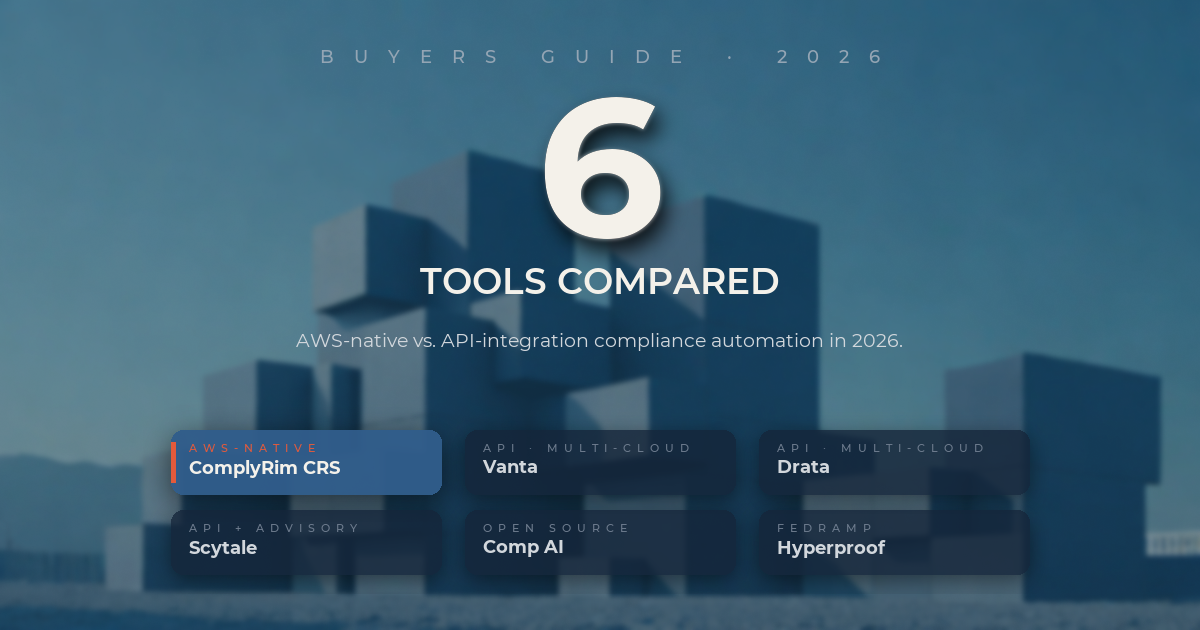
If you're an AWS customer preparing for SOC 2, ISO 27001, HIPAA, PCI DSS, or FedRAMP, you have three categories of tools to choose from in 2026: AWS-native (deployed as AWS infrastructure), API-integration platforms (connect to AWS), and consultant engagements (humans, not software). This guide compares the most-cited options across every dimension AWS buyers actually evaluate — deployment model, pricing predictability, framework coverage, and time-to-output.
Quick answer: For AWS customers who need a compliance readiness report in minutes — not weeks — the AWS-native category is the right choice. ComplyRim's five-product suite (Compliance Readiness Snapshot from $99.99/scan, Vendor Triage from $149/mo, Control Design Pro from $2,199/year, TraceRoot from $299/mo, AgentSpendrix from $399/mo) deploys via CloudFormation, runs in your AWS region, and is billed on your existing AWS invoice. For non-AWS environments or extensive multi-cloud scope, Vanta and Drata remain the dominant API-integration platforms.
What is compliance automation for AWS?
Compliance automation for AWS is software that performs the security checks, evidence collection, and audit-readiness work that compliance frameworks like SOC 2, ISO 27001, HIPAA, PCI DSS, and FedRAMP require — using direct access to your AWS environment instead of manual spreadsheets or human consultants.
The output is the same as a traditional compliance engagement: a control inventory, a gap analysis, and a remediation roadmap. The difference is the time and cost. A consultant takes 6 to 12 weeks and bills $15,000 to $50,000. AWS-native compliance automation completes the assessment in under 30 minutes for $99 per month.
There are two architectural categories of compliance automation:
- AWS-native tools deploy as AWS infrastructure via CloudFormation. They run in the customer's AWS region using a read-only IAM role. Customer data never leaves the customer's AWS environment. Billed on the customer's AWS invoice.
- API-integration platforms connect to AWS via API. They host customer data on the platform's own infrastructure. Billed on a separate vendor contract, typically $10,000 to $100,000 per year.
Both categories produce audit-ready output. The choice depends on architecture preferences (read-only IAM in customer's region vs. API integration), pricing tolerance ($99/month entry vs. $10K+/year minimum), and whether the team needs multi-cloud coverage (AWS-native is AWS-only by design).
How we compared each tool
This guide evaluates compliance automation tools across six criteria buyers actually use:
- Deployment model — CloudFormation-native (deploys as AWS infrastructure, runs in customer's region) vs. API integration (hosted SaaS that connects to AWS)
- Entry-tier pricing — what the lowest paid plan costs per month, billed annually
- Framework coverage — which compliance frameworks the tool supports out of the box
- Time to first readiness report — minutes, hours, or weeks from signup to audit-ready output
- Pricing predictability — single AWS invoice vs. separate contract with renewal increases
- Mid-market fit — designed for 100-1,000 employee teams, or built for enterprise
The 6 best AWS compliance automation tools in 2026
1. ComplyRim — best AWS-native suite for mid-market
Best for: AWS customers with 100 to 1,000 employees who need fast, affordable, audit-ready output across multiple compliance domains.
ComplyRim is the only multi-product compliance suite that deploys as AWS infrastructure. Five SaaS products, each sold individually on AWS Marketplace, cover the full compliance lifecycle: readiness assessment, vendor risk, control design, root cause analysis, and AI spend governance.
The five products:
- Compliance Readiness Snapshot (CRS) — $99.99/scan pay-as-you-go (Standard $799.99/mo, Premium $4,499.99/mo for unlimited scans) — 200+ automated AWS security checks across IAM, S3, CloudTrail, VPC, EC2, RDS, and KMS. Delivers a SOC 2 Type II, ISO 27001, HIPAA, PCI DSS v4.0, and ISO 42001 readiness score, gap analysis, and prioritized remediation roadmap in under 30 minutes.
- Vendor Triage — $149 to $999/month, or $50/assessment pay-as-you-go — AWS-native third-party risk management. 78 industry-standard questions across 8 security domains (including AI/ML ethics assessments), multi-stakeholder routing for 85%+ completion rate, audit-ready PDF reports. Vendor assessments in 2-3 days vs. 2-3 weeks industry baseline.
- Control Design Pro — From $2,199/year (Basic, 10 users · 12-month contract on AWS Marketplace) — AI-assisted control design and operating effectiveness assessment using the 5W+H framework (Who, What, Where, When, Why, How). AI pre-fills Control Design Adequacy questions; assessor confirms or overrides with required comments. Cuts assessment time from 5 hours to 45 minutes. All industries. No setup.
- TraceRoot — $299 to $1,499/month — AI-assisted root cause analysis with a guided 5-step workflow: PreWork, Causes, Fishbone Analysis, 5 Why, Corrective Actions. Reduces MTTR by up to 40% with audit-ready PDF and CSV reports in minutes.
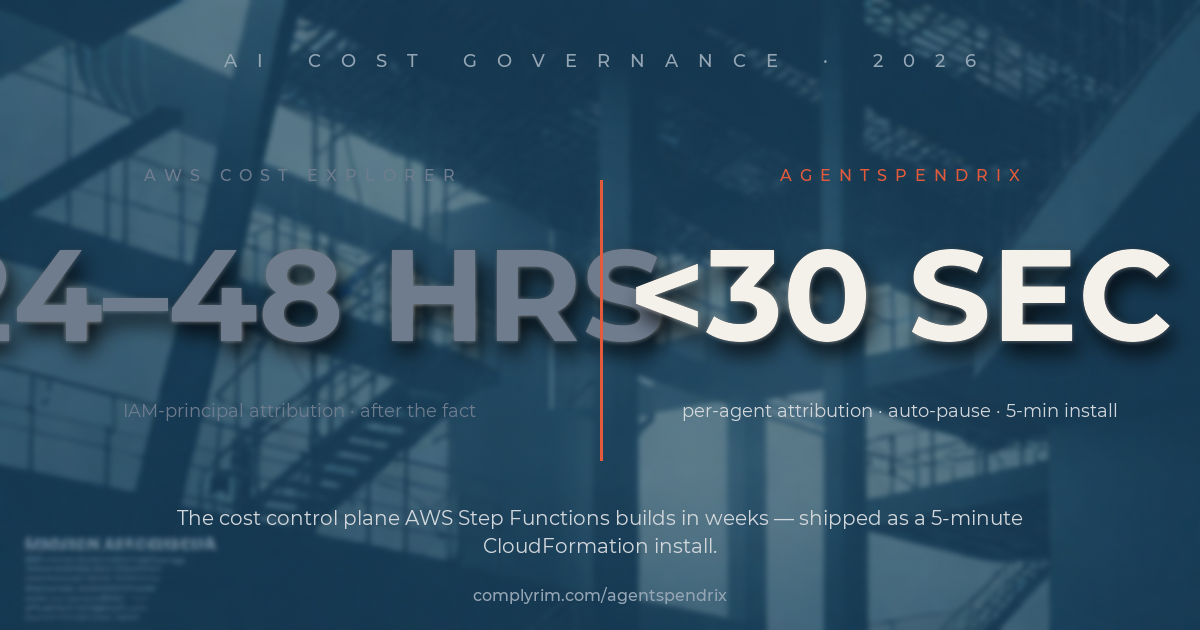
- AgentSpendrix — $399 to $2,999/month — Real-time per-agent AWS Bedrock cost attribution with sub-30-second latency, automated budget enforcement, and 30-90 day spend forecasting at 80% accuracy.
Deployment model: CloudFormation-native, read-only IAM, customer's AWS region, billed on customer's AWS invoice. No agents, zero production impact, two-minute setup per product.
Pricing predictability: every product is billed on the customer's existing AWS invoice. No separate vendor contract, no renewal hike letters, no procurement cycle. AWS credits and committed spend apply.
Frameworks: SOC 2 Type II, ISO 27001, HIPAA, PCI DSS v4.0, ISO 42001, FedRAMP. CRS performs automated checks across all 5 frameworks; the others apply framework-aligned templates.
Trial: 14-day free trial on every product, AWS credit eligible.
Limitation: AWS-only by design. ComplyRim does not support Azure, GCP, on-premises, or hybrid deployment. Teams running multi-cloud workloads need to choose between AWS-native architecture (ComplyRim) and multi-cloud coverage (Vanta, Drata).
2. Vanta — best API-integration platform for multi-cloud
Best for: companies running multi-cloud workloads who need extensive non-AWS integration coverage.
Vanta is the dominant API-integration GRC platform. It connects to AWS via API and 375+ other integrations across cloud, identity, HR, developer tooling, device management, and security tooling. Vanta runs hourly automated tests, ties failures back to controls, and routes remediation to owners.
Vanta's strengths:
- 375+ integrations including AWS, GCP, Azure, GitHub, Okta, Workday, Jamf, and JumpCloud
- 35+ frameworks including FedRAMP, CMMC, ISO 27001, SOC 2, HIPAA, GDPR
- AWS Strategic Collaboration Agreement (October 2025) and 6,000+ AWS customers
- Vanta Agents (March 2026): Compliance Agent, TPRM Agent, Customer Trust Agent
- Adaptive business unit scoping for organizations segmenting compliance by product, region, or team
Vanta's tradeoffs:
- Entry-tier pricing starts at ~$10,000 per year (Vendr median ~$19,800/year). 100x more expensive than ComplyRim CRS at $99/month for AWS-native readiness output.
- 40% renewal price hikes reported in G2 reviews, often without warning.
- API integration, not infrastructure deployment. Customer data routes through Vanta's hosted infrastructure rather than running entirely in the customer's AWS region. Acceptable for most use cases; not acceptable for AWS GovCloud customers requiring no data egress.
- Rigid 2-year contracts with no early-exit clause and auto-debit billing — refund disputes have surfaced repeatedly in Capterra reviews.
Architecture comparison: Vanta connects to AWS. ComplyRim deploys as AWS infrastructure. For a CISO whose audit committee asks "where does our SOC 2 evidence physically reside," Vanta's answer is "Vanta's cloud." ComplyRim's answer is "your AWS region."
3. Drata — best for fast-growing SaaS companies
Best for: SaaS companies that anticipate scaling beyond mid-market and want platform features that grow with them.
Drata crossed $100 million ARR in FY25 and serves 7,000+ customers. The platform launched "The New Drata Experience" UI redesign in April 2026 — AI-powered Action Panel, configurable tables, dark mode, WCAG accessibility — and appointed Bharat Guruprakash as CPTO to lead its agentic trust management roadmap.
Drata's strengths:
- 45+ AWS services covered via API integration
- AI-powered TPRM, automated questionnaire response, embedded Trust Center creation
- Active investment in brand and developer experience (Drataverse Live SF June 2026)
- Strong category leadership in mid-market SOC 2 with public customer case studies
Drata's tradeoffs:
- Foundation tier $7,500-$15K/year (1 framework, <50 employees). Advanced $15K-$25K/year (2-3 frameworks, 50-250 employees). Enterprise $25K-$100K+/year. Vendr median contract ~$25,000/year — 250x more expensive than ComplyRim CRS at $99/month.
- G2 reviewers cite weak vendor risk management and monitoring inaccuracies (controls reported green when underlying configurations failed)
- Hard-coded settings like log retention, configs requiring CSM contact, and steep renewal price jumps
- No CloudFormation deployment. Same API-integration architecture as Vanta — customer data routes through Drata's infrastructure.
4. Scytale — best for first-time SOC 2 buyers needing advisory
Best for: first-time compliance buyers who want a tool plus expert advisory in a single contract.
Scytale combines automation (90% of evidence collection) with dedicated advisory consultants who guide policy customization and auditor queries. Named a 2026 G2 Best Software Award winner in GRC.
Scytale's strengths:
- Bundled advisory + tooling — useful for first-time SOC 2 buyers who don't have a compliance team
- Strong policy template library
- 90% evidence collection automation claim
Scytale's tradeoffs:
- Higher TCO than tool-only platforms because advisory is included
- Not AWS-native; same API-integration model as Vanta and Drata
- Less suitable for teams that already have a compliance manager and want tooling only
5. Comp AI — best open-source option for cost-sensitive startups
Best for: startups with engineering capacity to self-host who prioritize lowest licensing cost.
Comp AI launched in late 2025 as an open-source AGPLv3 compliance automation platform. As of February 2026, 4,000+ companies, $1 million ARR in 4 months from launch, $2.6M pre-seed (OSS Capital, Grand Ventures, angels from Sentry, Freshworks, Deel, Pipe).
Comp AI's strengths:
- Open source AGPLv3 licensing — self-host at zero licensing cost
- 100+ integrations
- 25+ frameworks (SOC 2, ISO 27001, HIPAA, PCI DSS 4.0, GDPR, CCPA, NIST)
- AI agents for evidence collection, policy generation, risk scoring
Comp AI's tradeoffs:
- Self-host requires DIY ops capacity. A startup deploying Comp AI carries the operational cost of running a compliance platform on top of running the rest of its infrastructure.
- Not AWS-native. No CloudFormation deployment, no AWS Marketplace presence.
- Paid tier starts at $199/month ($2,388/year) — still 24x more expensive than ComplyRim CRS at $99/month, but the cheapest paid option in the API-integration category.
- Early-stage support ecosystem; less mature than Vanta or Drata.
6. Hyperproof — best for FedRAMP-specific workflows
Best for: federal contractors specifically pursuing FedRAMP authorization who need a dedicated FedRAMP module.
Hyperproof's GRC platform offers templates for FedRAMP High, Moderate, and Low Impact levels. The platform automates evidence collection and links evidence to requirements with a focus on the federal contracting workflow.
Hyperproof's strengths:
- Strong FedRAMP-specific tooling (template depth across all impact levels)
- Multi-framework support including FedRAMP, CMMC, NIST 800-53, NIST 800-171, ISO 27001, SOC 2
Hyperproof's tradeoffs:
- Enterprise-tier pricing (contract pricing, opaque)
- Not AWS-native; no CloudFormation deployment model
- Best fit for federal contractors specifically; less differentiated for commercial SOC 2 buyers