If you bought Vanta two years ago to fast-track SOC 2, you're now living with a renewal quote you didn't expect. G2 and Capterra reviewers post the same story month after month: 40% price increases at renewal with no warning, two-year contracts with no early-exit clause, auto-debit billing disputes that don't get resolved. One Capterra reviewer this year called the experience "parasitic."
Vanta's response in 2026 has been to push deeper, not cheaper. In October 2025 they signed an AWS Strategic Collaboration Agreement and started branding themselves "built for AWS — not just compatible." On March 19, 2026 they launched three specialized AI agents (Compliance, TPRM, Customer Trust) and on April 2 they joined the Alliance for Digital Innovation with AWS GovCloud hosting, FedRAMP 20x with OSCAL export, and CMMC POA&M support to attack the public sector.
It's a serious roadmap. It's also expensive, locked-in, and built around an integration model that AWS-first teams are starting to reject. This post breaks down why mid-market AWS customers — especially first-audit teams between 100 and 1,000 employees — are leaving Vanta for AWS Marketplace–native alternatives, and what to evaluate if you're in that group.
Quick Answer
Vanta is a good fit for enterprise security teams that already have a $20K–$80K/year compliance budget, multiple framework programs running in parallel, and the staff to manage a separate vendor relationship. It is increasingly a poor fit for AWS-first mid-market teams getting their first audit done, because:
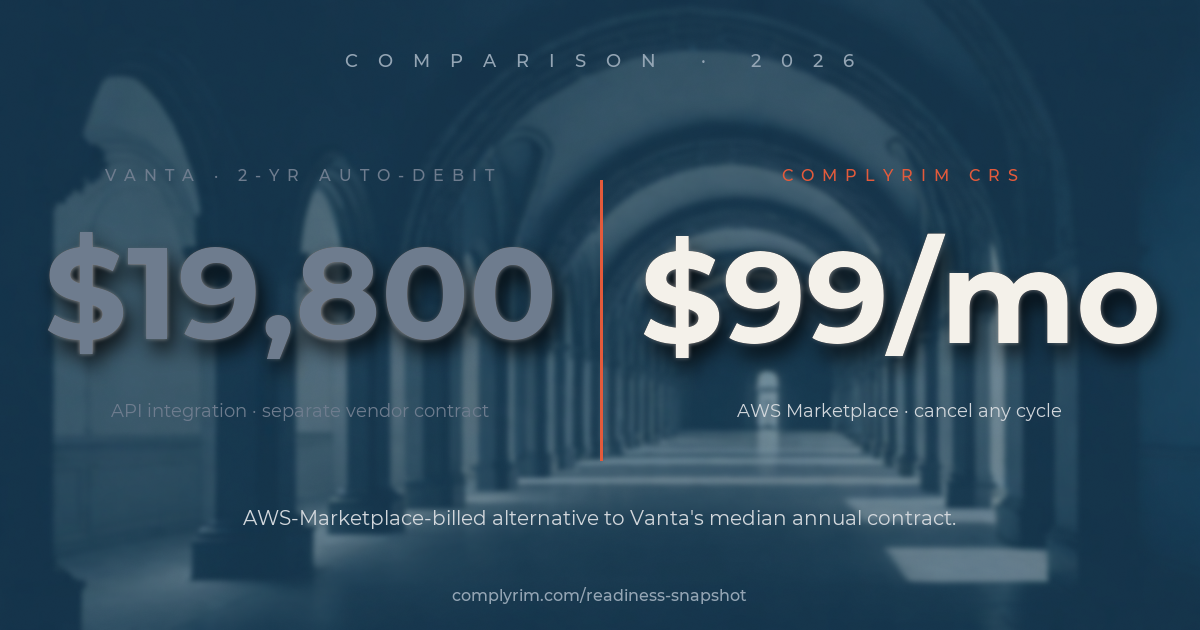
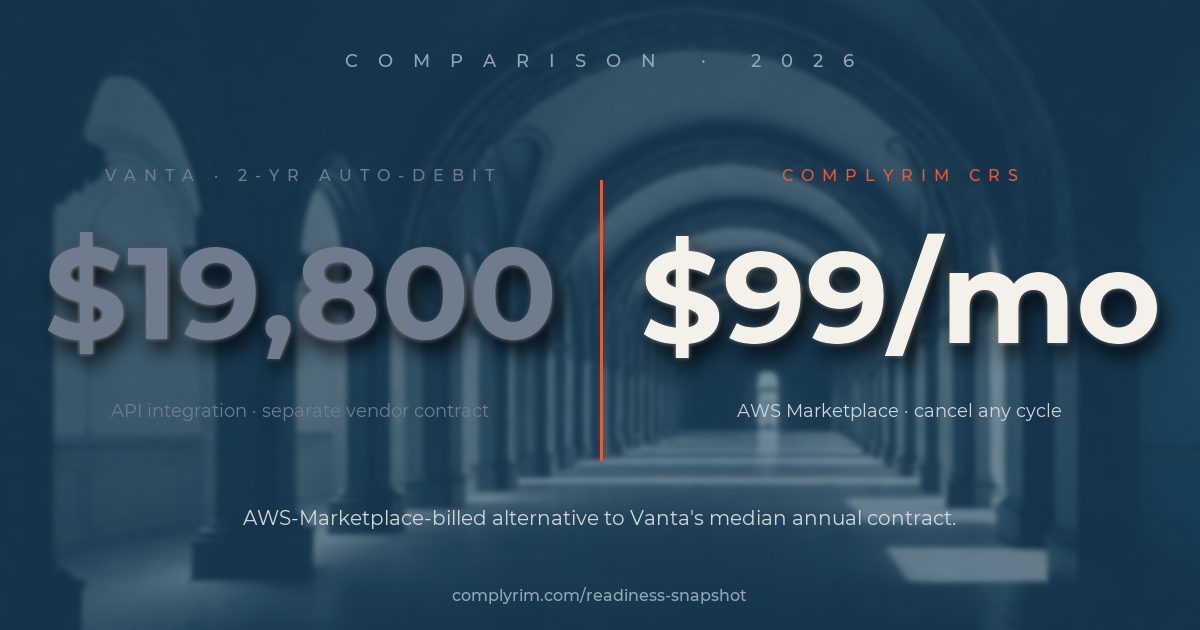
- Pricing starts around $10K/year — typical contracts hit ~$19,800 — and renewals are reportedly jumping 40% without warning.
- The deployment is integration-based, not infrastructure-based. Even after the AWS partnership, Vanta connects to your AWS account via API; it does not run as AWS infrastructure in your region.
- Contracts are commonly two-year, auto-debit, with no early-exit clause per Capterra reviews. AWS Marketplace alternatives bill on your existing AWS contract.
- Less-common frameworks aren't maintained at the same depth, and add-ons for vendor risk, customer trust, and AI agents stack quickly.
If those sound familiar, the rest of this post explains where the gaps are and what teams are switching to.
At a Glance: Complyrim vs Vanta
| Attribute | Vanta | Complyrim |
|---|---|---|
| Entry price | ~$10,000/year | $99/month (CRS) |
| Median contract | ~$19,800/year (Vendr) | $99–$1,499/month per product |
| Customer count (Apr 2026) | ~14,000 (6,000+ on AWS) | Mid-market, AWS-first |
| Pricing model | Annual SaaS, often 2-year auto-debit | AWS Marketplace metering — your AWS bill |
| AWS deployment | API integration, hosted by Vanta | CloudFormation + read-only IAM in your region |
| Setup time | Weeks of configuration | 2–30 minutes (varies by product) |
| Framework count | 35+ | SOC 2, ISO 27001, HIPAA, PCI DSS v4.0, ISO 42001, NIST CSF |
| Audit output | Trust center + integrations dashboard | Audit-ready PDF + remediation roadmap |
| AI features | 3 specialized agents (Mar 2026 launch) | AI pre-fill in Control Design Pro, AI Assist in TraceRoot |
| Renewal price predictability | G2: 40% hikes reported without warning | Predictable Marketplace metering, AWS credits eligible |
| Contract terms | 2-year auto-debit common | Your existing AWS contract terms |
| Vendor risk | TPRM Agent (add-on) | Vendor Triage as a separate $149–$999/mo product (or $50/assessment) |
| Lead product for control assessment | Multi-framework Trust + add-ons | Control Design Pro from $2,199/year (12-month contract) |
The "at a glance" matters because every difference below flows from two rows: how it's deployed, and how it's billed.
The Pricing Problem: Why "Built for AWS" Still Costs $20K
Vanta's marketing in 2026 leans hard on the AWS partnership, but the pricing model didn't move. Vendr data still puts the median Vanta contract around $19,800 per year, with entry tiers starting at roughly $10,000. That's a separate vendor relationship, a separate procurement cycle, and a separate invoice. None of those change because of an AWS Strategic Collaboration Agreement.
Complyrim took a different route: every product ships through AWS Marketplace, billed against your existing AWS contract. CRS — Compliance Readiness Snapshot — starts at $99 per month with 200+ automated security checks across IAM, S3, CloudTrail, VPC, EC2, RDS, and KMS. That's a 100x price gap at the entry tier. Control Design Pro starts at $249 per month and replaces a 3–5 hour manual control-design assessment with a 45-minute AI-assisted workflow built on the 5W+H framework: who performs the control, what action they take, where evidence is stored, when it fires, why it exists, and how it is sustained.
For a first-audit team without a $20K compliance line item, the math doesn't work for Vanta. For a fifth-audit team that already has the budget and wants 35+ frameworks under one roof, Vanta still wins. The real shift in 2026 is that the first group is no longer assuming they have to start with Vanta and graduate later.
Deployment vs Integration: What "Built for AWS" Actually Means
This is the technical distinction the marketing copy blurs. There are two ways a compliance tool can work with AWS:
Integration model. The tool is hosted by the vendor. It connects to your AWS environment via API keys or a cross-account role, pulls metadata, and renders it in the vendor's UI. Your data leaves your AWS region and lives in the vendor's tenant. Vanta uses this model. Drata uses this model. So does almost every "compliance platform."
Deployment model. The tool ships as a CloudFormation template. You deploy it into your own AWS account, in the region you choose, with a read-only IAM role you control. The vendor never holds your raw data — they meter usage and bill through AWS Marketplace. Complyrim products use this model.
For most SaaS workloads the distinction is academic. For compliance — where the entire point is provable control over where data lives, who has access, and how evidence is collected — it isn't. AWS GovCloud customers, FedRAMP-track teams, and any organization whose audit scope includes "no data egress" hit the difference immediately.
Vanta's April 2026 GovCloud announcement is hosted: customer data still leaves the customer's GovCloud environment for Vanta's. Complyrim runs CRS directly in the customer's AWS GovCloud region — read-only IAM, no data egress, the deployment is the architecture. If your auditor asks where compliance evidence lives, "in our own VPC" is a different answer than "in Vanta's tenant."
The 40% Renewal Surprise
The most consistent complaint about Vanta in 2026 is renewal pricing. G2 and Capterra reviewers describe a pattern: a quiet email shortly before the renewal date, a quote 30–40% higher than the prior contract, and very little room to negotiate once the auto-renew clock has run. Drata gets similar reviews on its Advanced tier; OneTrust customers describe multi-week procurement cycles every cycle.
The cause is structural. Annual SaaS contracts with vendors who don't bill through your existing infrastructure can re-price on every renewal. If your CFO doesn't see the line item until renewal week, you have very little negotiating leverage.
AWS Marketplace pricing is metered against your AWS contract. You pay through the AWS invoice you already have. You can apply existing AWS credits. There's no separate procurement cycle, no separate accounts payable lifecycle, and the renewal terms are your AWS contract terms — not a one-off compliance vendor's. For a CFO managing a 100–1,000 employee company's spend, that predictability is the whole point.