Time, engineer hours, and missed opportunities add up fast — here's the real bill for doing compliance the old way.
Most compliance teams only see the invoice. They miss the real cost.
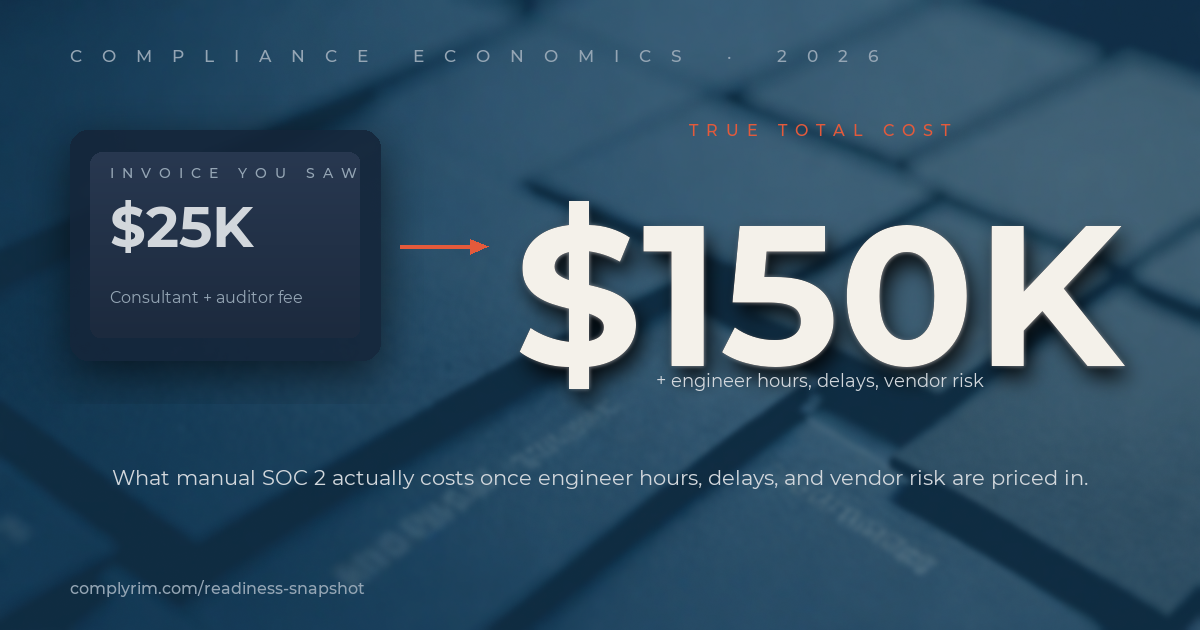
When a compliance consultant quotes $35,000 for a SOC 2 readiness assessment, that number feels painful. But it's actually the smallest part of what manual compliance costs. The bigger bill — measured in hours, delays, and risk exposure — never shows up on a single invoice. It's distributed across your team, your timeline, and your customers' trust.
Here's what manual compliance actually costs, and why the math has shifted.
The Invoice Is Just the Starting Point
The typical compliance engagement starts with a consultant quote. For SOC 2 readiness, expect $15,000–$50,000. For ISO 27001, add another $20,000–$40,000. For a HIPAA gap analysis: $10,000–$30,000.
That's real money. But it buys you a point-in-time assessment delivered 8–12 weeks after you sign the contract. By the time the report arrives, your environment has changed. New services deployed. Team members onboarded. Architecture shifted.
You paid for a snapshot of a system that no longer exists.
The Engineer-Hours Nobody Counts
Every compliance engagement — whether run by a consultant or internally — requires significant time from your own team. Here's what that looks like in practice:
- Evidence collection: 40–80 hours per framework gathering screenshots, access logs, configuration exports, and policy documents
- Interviews and workshops: 20–40 hours of engineering and ops time for consultant walkthroughs
- Remediation tracking: 30–60 hours managing spreadsheets, chasing control owners, updating statuses
- Follow-up documentation: 20–40 hours writing or updating policies to satisfy auditor questions
A modest SOC 2 engagement can easily consume 150+ engineering hours. At a fully-loaded rate of $150/hour, that's $22,500 in labor costs that never appears on the compliance invoice.
For a 50-person company, that's roughly 3% of annual engineering capacity spent on a single compliance cycle. Multiply by annual recertification and the true total compounds quickly.
The Delay Tax
Compliance timelines impose a second-order cost that rarely gets measured: they delay everything else.
When a compliance project is running, engineering teams instinctively slow down. Nobody wants to change infrastructure that's "in scope" for an audit. Feature launches get pushed. Migrations get deferred. The unofficial message is: hold steady until the auditors are done.
For a startup preparing for its first SOC 2 Type II, that window can span 12 months — the full observation period plus preparation time on either side. During those 12 months, your team is carrying a compliance anchor.
The opportunity cost is real: deals delayed, features deferred, competitive ground lost. It's the cost that never appears on a budget line but shows up everywhere else.
The Spreadsheet Trap
The vast majority of mid-market compliance programs run on spreadsheets. Not because spreadsheets are good at this — they aren't — but because spreadsheets are familiar and free.
Here's what "free" actually costs:
No version control. When an auditor asks "what was your access review process on October 15th?" and the answer is buried in a shared drive with 47 versions of the same file, you spend hours reconstructing history that a proper system would surface in seconds.
No audit trail. Spreadsheets don't log who changed what, or when. Every entry is a trust question. Auditors know this — and they probe harder when your evidence is a manually-maintained sheet.
No integration. Your spreadsheet doesn't know your AWS environment changed last Tuesday. It knows what someone typed three months ago. The gap between that spreadsheet and your actual control posture is your compliance risk.
No reminders. Spreadsheets don't alert you when a vendor's SOC 2 certificate expired or when a quarterly access review is due. That means compliance tasks get done when someone remembers — which means they often get done late, poorly, or not at all.
The cost of the spreadsheet trap is measured in audit findings, failed certifications, and the grinding inefficiency of manual reconciliation.
The Vendor Risk Blind Spot
If your company uses more than 20 vendors — SaaS tools, cloud infrastructure, subprocessors, contractors — you have a third-party risk problem whether you've acknowledged it or not.
The average mid-market company manages 150–300 active vendor relationships. Assessing each one manually — sending questionnaires, chasing responses, reviewing SOC 2 reports, scoring risk — takes 2–3 weeks per vendor if done properly.
Nobody does it properly.
What actually happens: you assess the 10 vendors your auditor will definitely ask about, you accept vendor-provided security summaries without independent verification, and you skip the long tail of vendors entirely because you don't have the capacity.
The hidden cost here isn't a spreadsheet. It's a vendor breach you didn't see coming because you had no systematic way to identify it. According to IBM's Cost of a Data Breach Report, third-party breaches cost organizations more than the average breach overall. The companies paying that bill typically had a vendor risk program on paper. They just didn't have the capacity to run it properly.